Are fractions giving you a hard time? Multiplying them might seem tricky at first, but once you know the simple steps, it becomes easy and even fun.
Imagine being able to solve fraction problems quickly and confidently every time. In this guide, you’ll discover exactly how to multiply fractions step-by-step, with clear explanations that make sense. Whether you’re a student, a parent helping with homework, or just someone who wants to brush up on math skills, this article is made for you.
Ready to unlock the secret to multiplying fractions effortlessly? Let’s dive in and master this essential math skill together!
Basic Concepts
Understanding the basic concepts of fractions is essential before multiplying them. Fractions represent parts of a whole and help express numbers between integers. Grasping what fractions are and recognizing their types will make multiplication simpler.
What Are Fractions
A fraction shows a part of a whole or a set. It has two numbers separated by a line. The top number is the numerator. It tells how many parts you have. The bottom number is the denominator. It shows how many equal parts the whole is divided into.
Fractions can represent numbers less than one, equal to one, or greater than one. They help in measuring, dividing, and comparing quantities in daily life and math problems.
Types Of Fractions
There are three main types of fractions. Proper fractions have a numerator smaller than the denominator. For example, 3/4 is a proper fraction.
Improper fractions have a numerator equal to or larger than the denominator. For example, 7/4 is an improper fraction. These can be changed into mixed numbers.
Mixed numbers combine a whole number and a proper fraction. For example, 2 1/3 is a mixed number. Understanding these types helps in multiplying fractions correctly.

Credit: www.mashupmath.com
Multiplying Fractions
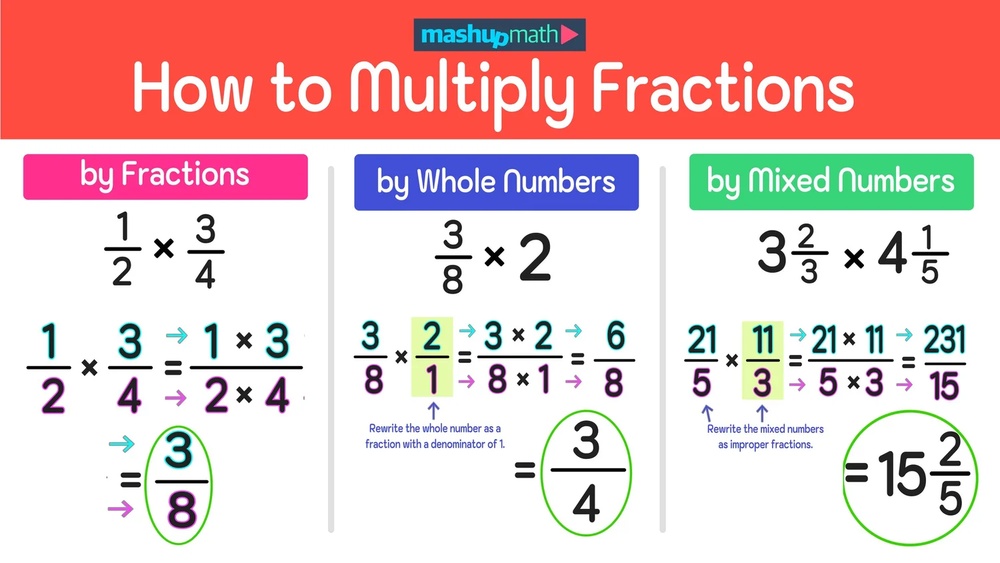
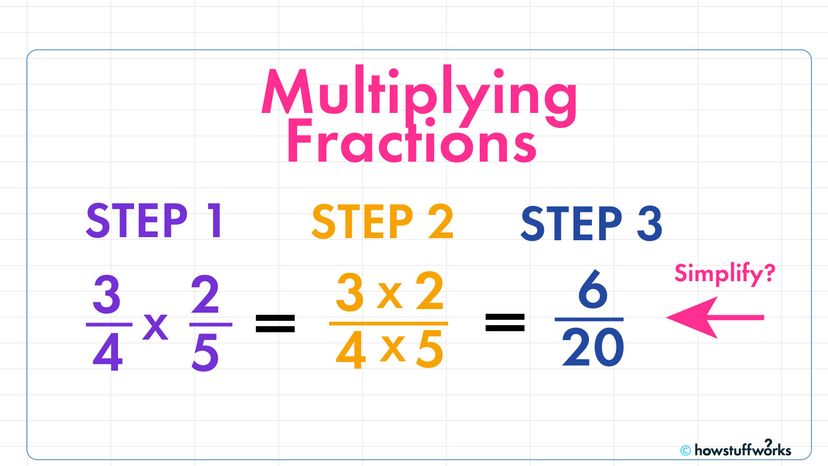
Multiplying fractions is a simple process that involves two main steps. First, multiply the top numbers, called numerators. Next, multiply the bottom numbers, called denominators. After that, simplify the fraction if possible. This method works for all fractions, including improper and mixed numbers.
Understanding how to multiply fractions helps in many areas of math. It makes solving problems easier and faster. Let’s look at each step closely for clear understanding.
Multiply Numerators
Start by multiplying the numerators of both fractions. The numerator is the number on the top. For example, if the fractions are 2/3 and 4/5, multiply 2 by 4. The result, 8, becomes the new numerator.
This step is straightforward. Just multiply the top numbers as if they were whole numbers. No need to find common denominators here.
Multiply Denominators
Next, multiply the denominators of both fractions. The denominator is the bottom number. Using the same example, multiply 3 by 5. The result, 15, becomes the new denominator.
Multiplying denominators is just like multiplying numerators. This gives the size of the new fraction’s parts.
Simplifying Results
After multiplying fractions, the result may look complex. Simplifying makes the answer easier to understand. It helps to see the fraction in its simplest form. This step improves clarity and accuracy in math problems.
Find Greatest Common Factor
First, find the Greatest Common Factor (GCF) of the numerator and denominator. The GCF is the largest number that divides both without a remainder. Dividing by the GCF reduces the fraction to simpler terms. This step makes the fraction easier to work with and understand.
Reduce To Lowest Terms
Divide the numerator and denominator by their GCF. This process is called reducing to lowest terms. It shrinks the fraction to its simplest form. A fraction in lowest terms has no common factors other than one. Reduced fractions are cleaner and easier to compare or use in calculations.
Convert Improper Fractions
Sometimes the result is an improper fraction, where the numerator is larger than the denominator. You can convert it into a mixed number for easier reading. Divide the numerator by the denominator to find the whole number part. The remainder becomes the new numerator over the original denominator. Mixed numbers are more intuitive for many people.
Working With Mixed Numbers
Working with mixed numbers in fraction multiplication needs a clear method. Mixed numbers combine whole numbers and fractions. Multiplying them directly is tricky. Convert mixed numbers to improper fractions first. This step makes multiplication easier. After conversion, multiply and simplify the result. This approach helps avoid errors and keeps calculations simple.
Convert To Improper Fractions
Start by changing mixed numbers to improper fractions. Multiply the whole number by the denominator. Add this to the numerator. Place this sum over the original denominator. For example, 2 3/4 becomes 11/4. This form makes multiplication straightforward. Use this method for every mixed number in the problem.
Multiply And Simplify
Multiply the numerators of the improper fractions. Then multiply the denominators. Write the new fraction with these products. Simplify the fraction by dividing by the greatest common factor. If the result is an improper fraction, convert it back to a mixed number. This gives a clear, easy-to-understand answer. Simplifying keeps numbers neat and easier to work with.
Multiplying Whole Numbers By Fractions
Multiplying whole numbers by fractions is a key skill in math. It helps solve many real-life problems easily. The process is simple once you know the steps. First, change the whole number into a fraction. Then multiply and simplify the result. This section explains these steps clearly and simply.
Convert Whole Numbers
Whole numbers can be written as fractions by placing them over 1. For example, 5 becomes 5/1. This helps in multiplying because fractions multiply numerators and denominators. Always convert whole numbers first to keep the process smooth and clear.
Multiply And Simplify
Next, multiply the numerators of both fractions. Then multiply the denominators. For example, multiply 5/1 by 2/3. Multiply 5 and 2 to get 10. Multiply 1 and 3 to get 3. The answer is 10/3. Finally, simplify if possible. You can also write improper fractions as mixed numbers for easier understanding.
Credit: science.howstuffworks.com
Common Mistakes
Multiplying fractions may seem easy, but many learners make common mistakes. These errors can cause wrong answers and confusion. Knowing these pitfalls helps improve accuracy and builds confidence in math.
Simple steps are often overlooked. Small errors like mixing numerators and denominators or skipping simplification can affect the final result. Paying attention to details makes a big difference.
Avoiding Errors In Multiplication
One common error is mixing numerators with denominators. Always multiply the top numbers together. Then multiply the bottom numbers together. Keep these steps clear and separate.
Another mistake is forgetting to convert mixed numbers to improper fractions first. This step is necessary before multiplying. Skipping it leads to incorrect answers.
Also, some students multiply across diagonals by mistake. Focus only on straight multiplication of numerators and denominators. Avoid cross multiplication when multiplying fractions.
Simplifying Before Multiplying
Simplifying fractions before multiplying saves time and effort. It reduces large numbers and makes calculations easier. Cancel common factors from numerators and denominators before multiplying.
Not simplifying early can cause very large numbers that are hard to work with. This increases chances of errors. Simplify whenever possible to avoid this.
After multiplying, always simplify the final fraction to its lowest terms. This step ensures the answer is neat and easy to understand. It also helps check your work.
Practice Tips
Practice makes perfect. To improve multiplying fractions, use practical strategies. These help build confidence and understanding. Focus on simple, clear exercises. Try different methods to see what works best.
Use Visual Aids
Visual aids show how fractions multiply. Use fraction bars or pie charts. These tools make abstract ideas clear. Seeing parts of a whole helps grasp the concept. Color-code the parts to spot numerators and denominators. Draw pictures to represent each step. This makes learning more interactive and fun.
Try Real-life Examples
Real-life examples make practice meaningful. Use cooking or baking measurements. For example, multiply half a cup by a third. This shows fractions working in daily life. Shopping discounts are another good example. Calculate fractions of prices to see multiplication in action. Practical problems stick better in memory.

Credit: science.howstuffworks.com
Frequently Asked Questions
How To Multiply Fractions Step By Step?
Convert mixed numbers to improper fractions. Multiply numerators together. Multiply denominators together. Simplify the fraction by dividing numerator and denominator by their GCF. Convert improper fractions to mixed numbers if needed.
How Do I Multiply A Fraction With Different Denominators?
Multiply the numerators of both fractions to get the new numerator. Multiply the denominators to get the new denominator. Simplify the fraction by dividing both by their greatest common factor. Convert to a mixed number if needed.
What Are The Three Rules Of Multiplying Fractions?
Multiply the numerators together. Multiply the denominators together. Simplify the resulting fraction to its lowest terms.
How Can I Multiply Mixed Fractions?
Convert mixed fractions to improper fractions. Multiply numerators together and denominators together. Simplify the result. Convert to a mixed number if needed.
Conclusion
Multiplying fractions is simple with the right steps. First, multiply the top numbers together. Next, multiply the bottom numbers. Then, simplify the fraction to make it easier. Remember to change mixed numbers to improper fractions before multiplying. Practice helps you gain confidence and speed.
Keep these steps in mind, and multiplying fractions will feel natural. Math becomes less scary and more fun with practice. Try different problems to improve your skills every day.