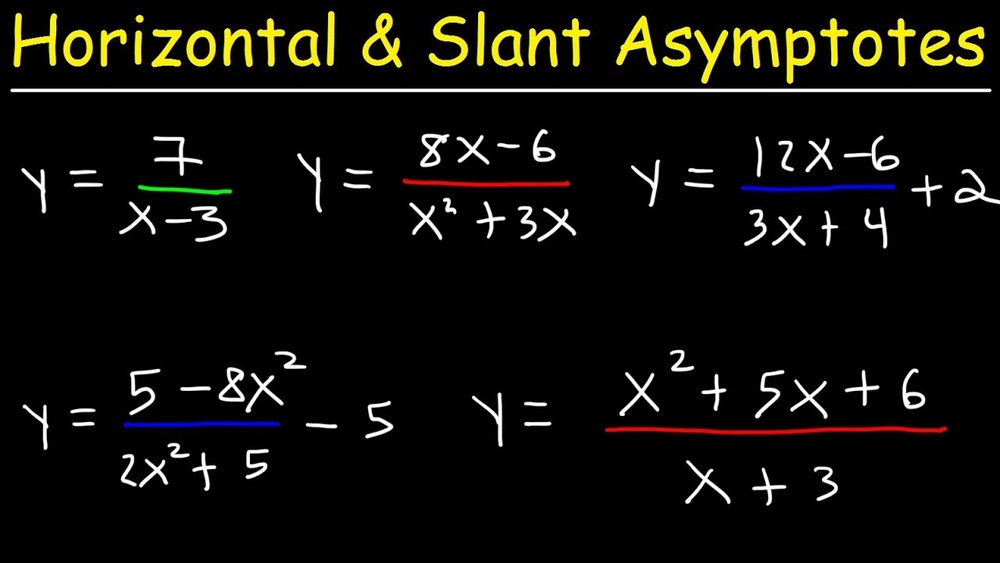
Are you struggling to understand horizontal asymptotes and how to find them? You’re not alone.
Many students and learners find this concept tricky at first. But once you grasp the simple steps to identify horizontal asymptotes, your confidence with functions and graphs will soar. You’ll discover easy-to-follow methods to find horizontal asymptotes for different types of functions.
Whether you’re dealing with rational or exponential functions, you’ll learn practical tips that make the process clear and straightforward. Keep reading, and by the end, you’ll be able to spot horizontal asymptotes quickly and use this knowledge to solve problems like a pro. Let’s dive in and simplify this important math concept together!

Credit: study.com
Horizontal Asymptotes In Rational Functions
Horizontal asymptotes show the behavior of a rational function as x approaches infinity or negative infinity. They help predict the function’s long-term trend. Rational functions are ratios of polynomials, and their horizontal asymptotes depend on the degrees of these polynomials. Understanding these rules makes it easier to find the asymptotes quickly and accurately.
Compare Degrees Of Numerator And Denominator
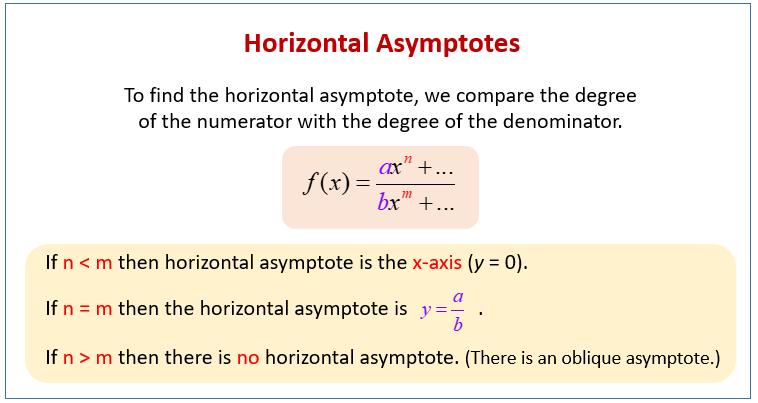
First, identify the degree of the numerator and denominator. The degree is the highest power of x in each polynomial. Let m be the degree of the numerator and n be the degree of the denominator. The relationship between m and n determines the horizontal asymptote.
Cases When Degree Numerator Less Than Denominator
If the degree of the numerator (m) is less than the degree of the denominator (n), the horizontal asymptote is y = 0. This means the function’s value gets closer to zero as x becomes very large or very small. The graph approaches the x-axis but never touches it.
Cases When Degrees Are Equal
If the degree of the numerator equals the degree of the denominator (m = n), the horizontal asymptote is a horizontal line y = a/b. Here, a is the leading coefficient of the numerator, and b is the leading coefficient of the denominator. This ratio gives the exact value of the asymptote.
Cases When Degree Numerator Greater Than Denominator
If the degree of the numerator (m) is greater than the degree of the denominator (n), the function does not have a horizontal asymptote. Instead, the graph may have an oblique or slant asymptote. The function grows without bound or decreases without bound as x moves far from zero.

Credit: www.youtube.com
Finding Asymptotes In Exponential Functions
Finding asymptotes in exponential functions helps understand their long-term behavior. Exponential functions often approach a fixed line as x moves toward positive or negative infinity. This line is the horizontal asymptote. Knowing how to find it clarifies the function’s limits and graph shape.
General Form Of Exponential Functions
The basic exponential function looks like f(x) = a · b^x + c.
Here, “a” is a coefficient, “b” is the base, and “c” is a constant shift.
The base “b” is positive and not equal to 1. It controls growth or decay.
Identifying The Constant Shift
The constant “c” shifts the graph vertically up or down.
This shift changes the horizontal asymptote from y = 0 to y = c.
Look at the function’s form to find this constant easily.
Determining The Horizontal Asymptote
As x approaches infinity, b^x grows or shrinks toward zero.
For growth (b > 1), the function heads to infinity, no asymptote there.
For decay (0 < b < 1), b^x approaches zero, so f(x) approaches c.
The horizontal asymptote is the line y = c, the constant shift.
End Behavior And Asymptotes
Understanding the end behavior of a function helps identify its horizontal asymptotes. As x moves toward positive or negative infinity, the function’s values approach certain limits. These limits often reveal the horizontal asymptotes. The function may get closer to a constant value, which forms the asymptote line that the graph never crosses or touches.
Studying how terms behave at the ends of the graph clarifies why horizontal asymptotes exist. Some terms shrink to zero, while constants stay steady. This balance between shrinking and constant terms determines the asymptote’s position.
Effect Of Exponential Terms Approaching Zero
Exponential terms with negative powers shrink as x grows large. For example, terms like 1/x or 1/x² approach zero. These shrinking terms lose influence on the function’s value at the extremes. When they approach zero, they do not affect the horizontal asymptote. The function then behaves like the constant or leading terms left behind.
This means the horizontal asymptote depends on terms that remain stable or grow slower. Exponential terms that fade away help the function settle toward a horizontal line. The graph flattens out and approaches the asymptote smoothly.
Role Of Constants In Horizontal Asymptotes
Constants play a key role in setting horizontal asymptotes. When the variable terms shrink or vanish, constants remain as the main part of the function. The function’s value gets closer to that constant as x becomes very large or very small.
For rational functions, constants often come from the ratio of leading coefficients. This ratio forms the horizontal asymptote line, such as y = a/b. Constants provide the steady level the graph approaches and helps predict the end behavior clearly.
Step-by-step Examples
Understanding how to find horizontal asymptotes becomes easier with clear examples. Step-by-step examples help you see the process in action. Practice with different types of functions to build confidence. Below are examples with rational and exponential functions. Also, try multiple practice problems to test your skills.
Example With Rational Function
Consider the rational function f(x) = (3x^2 + 5) / (2x^2 - 7). First, compare the degrees of numerator and denominator.
The degree of numerator m is 2. The degree of denominator n is 2.
Since m = n, find the ratio of leading coefficients. The leading coefficient of numerator is 3. The leading coefficient of denominator is 2.
Therefore, the horizontal asymptote is y = 3 / 2.
Example With Exponential Function
Look at the function g(x) = 5 - 2^(-x). As x approaches infinity, 2^{-x} approaches zero.
The function approaches 5 - 0 = 5. So, the horizontal asymptote is y = 5.
As x goes to negative infinity, 2^{-x} grows very large, so no horizontal asymptote on that side.
Multiple Practice Problems
Try these problems to practice finding horizontal asymptotes:
- Find the horizontal asymptote of
h(x) = (4x + 1) / (2x + 3). - Determine the horizontal asymptote of
k(x) = (x^3 + 2) / (x^2 + 5). - What is the horizontal asymptote of
m(x) = 7 + 3^x?
Check your answers by comparing degrees or limits as x approaches infinity.
Common Mistakes To Avoid
Finding horizontal asymptotes can be tricky for beginners. Many make simple errors that lead to wrong answers. Avoiding these mistakes helps you understand the concept better. Below are common errors to watch out for when finding horizontal asymptotes.
Misinterpreting Degree Comparisons
One common error is mixing up the degrees of numerator and denominator. The degree means the highest power of the variable. If the numerator’s degree is less than the denominator’s, the horizontal asymptote is y = 0.
If the degrees are equal, divide the leading coefficients for the asymptote. If the numerator’s degree is greater, no horizontal asymptote exists. Many confuse these rules or forget which degree to compare.
Ignoring Constant Terms In Exponentials
Some functions include exponential terms with constants. These constants affect the end behavior of the function. Ignoring them causes wrong predictions about horizontal asymptotes.
Always consider constants in the exponents when analyzing limits at infinity. They can change the horizontal asymptote or remove it completely.
Confusing Vertical And Horizontal Asymptotes
Vertical and horizontal asymptotes are different and serve different purposes. Vertical asymptotes occur where the function is undefined, usually where the denominator is zero. Horizontal asymptotes describe the function’s behavior at infinity.
Many confuse these two and apply the wrong method. Remember, vertical asymptotes are found by setting the denominator to zero, while horizontal asymptotes come from degree comparisons or limits.
Credit: smart.dhgate.com
Quick Tips For Success
Finding horizontal asymptotes can seem tricky at first. These quick tips will make the process clearer and faster. Follow them to spot horizontal asymptotes with confidence and ease. Simple steps lead to better understanding and fewer mistakes.
Use Leading Coefficients Wisely
Check the highest degree terms in numerator and denominator. Compare their powers to decide the asymptote. If degrees are equal, divide the leading coefficients. This result gives the horizontal asymptote’s value. Keep your focus on these main terms only.
Watch For Added Constants
Ignore constants that do not affect the degree. They do not change the horizontal asymptote. Only the highest degree terms matter in the long run. Constants can confuse, but they do not shift the asymptote. Stay alert to avoid common errors.
Check Graphs For Verification
Plot the function to see the curve’s behavior at extremes. The graph shows if your asymptote guess is correct. Look at the function as x goes to positive or negative infinity. Graphs are a great way to confirm your answers. Use them to build confidence in your work.
Frequently Asked Questions
How Do I Find The Horizontal Asymptote?
To find the horizontal asymptote, compare the degrees of numerator (m) and denominator (n). If m < n, asymptote is y = 0. If m = n, asymptote is y = leading coefficient of numerator divided by denominator. If m >n, no horizontal asymptote exists.
How To Find The Horizontal Asymptote Of An Exponential Function?
Find the constant term added or subtracted outside the exponential part. The horizontal asymptote equals this constant, y = c, in y = a·b^(kx) + c.
What Is The Rule For Horizontal And Slant Asymptotes?
For horizontal asymptotes, compare degrees of numerator (m) and denominator (n). If m
How To Find Ha In A Fraction?
To find the horizontal asymptote of a fraction, compare numerator and denominator degrees. If numerator degree is less, asymptote is y=0. If equal, asymptote is y = leading coefficient of numerator ÷ denominator. If numerator degree is higher, no horizontal asymptote exists.
Conclusion
Finding horizontal asymptotes becomes easy by comparing degrees of numerator and denominator. When the degree of the numerator is less, the asymptote is y = 0. If degrees are equal, divide leading coefficients to find y = a/b. No horizontal asymptote exists if numerator’s degree is higher.
Remember to check function types carefully. Practice with examples to gain confidence. This knowledge helps in understanding graphs and function behavior clearly. Keep these simple rules in mind to spot horizontal asymptotes quickly.